Why Banks Still Treat Tokenization Like a Pilot
Why bank tokenization projects stall before production: fragmented fiat rails, custody rules and real-time compliance, and why they must work as one infrastructure.

Tokenized assets have been the talk of institutional finance for years. Yet for every ambitious proof of concept, there are dozens of pilots that never graduate to production. The technology works—smart contracts can mint, burn, and transfer digital representations of real-world assets with near-instant settlement. So why do most initiatives stall just short of going live?
The answer isn’t the smart contract. It’s everything around it.
Banking leaders know that tokenization’s real promise lies not in the token itself but in the infrastructure that makes the token usable. Payments rails that connect to existing fiat systems. Custody arrangements that meet institutional standards. Compliance mechanisms that operate in real time across jurisdictions. Until these three layers work as a single, integrated infrastructure, tokenization will remain a pilot—a promising experiment, not a production product.
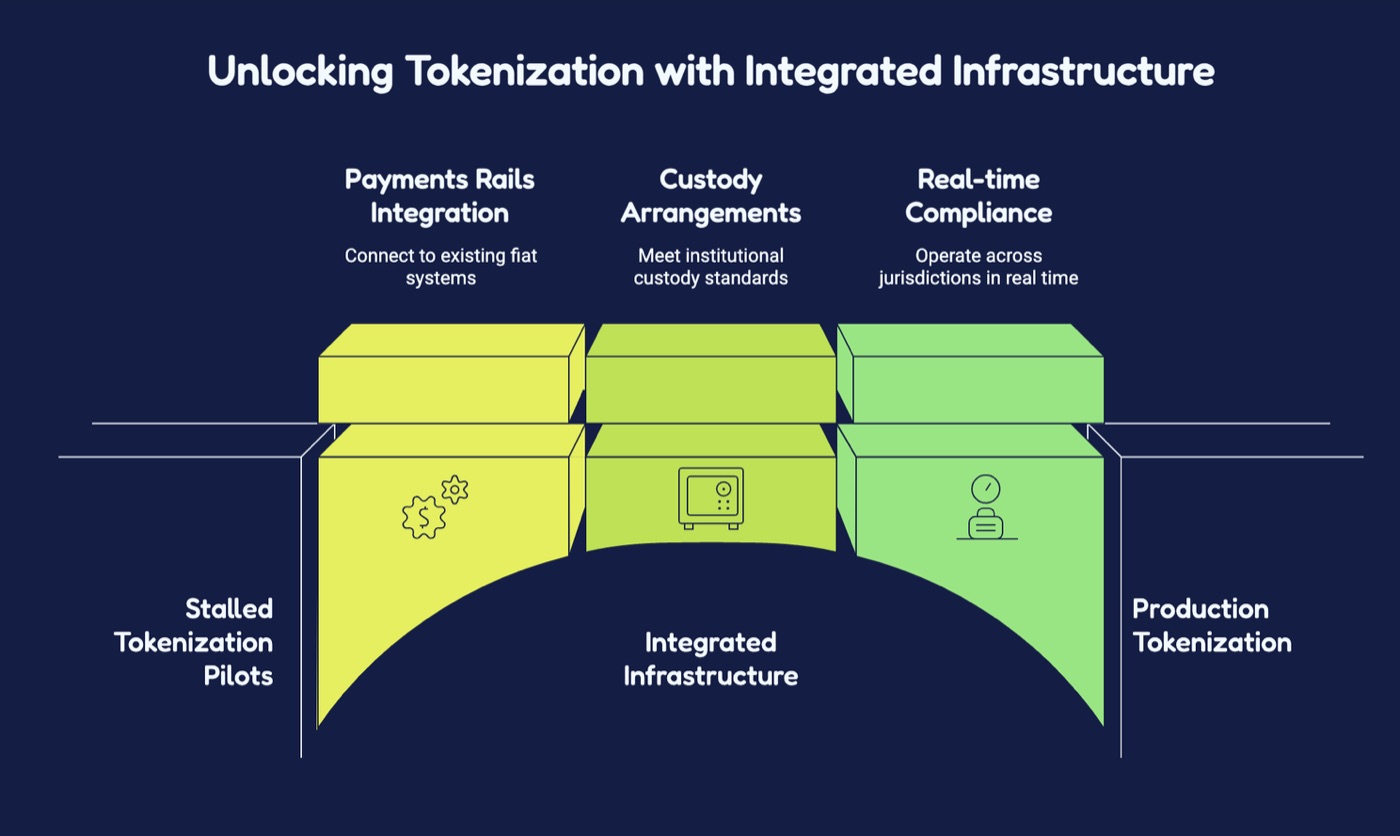
Let’s examine why each of these layers is a blocker, and what it takes to break through.
Fragmented Payments Rails Break the Flow
Ask any head of digital assets what keeps a tokenized bond or fund from going live, and they’ll likely point to the money flow. Most institutional tokenization pilots rely on permissioned DLT or hybrid models—think JPM Coin, the Canton Network, or proprietary bank consortiums. In theory, these networks allow near-instant settlement. In practice, getting fiat on and off the chain is still a fragmented, multi-step process.
Production-ready fiat on-ramps remain a patchwork. Stablecoins like USDC and USDT are emerging as settlement assets, but they introduce their own counterparty and regulatory risk for banks. Central bank digital currencies (CBDCs) promise a sovereign alternative, but only a handful are live, and none are seamlessly interoperable with private blockchains. Meanwhile, the existing payment infrastructure—SWIFT, Fedwire, TARGET2—is designed for batch processing, not continuous token settlement.
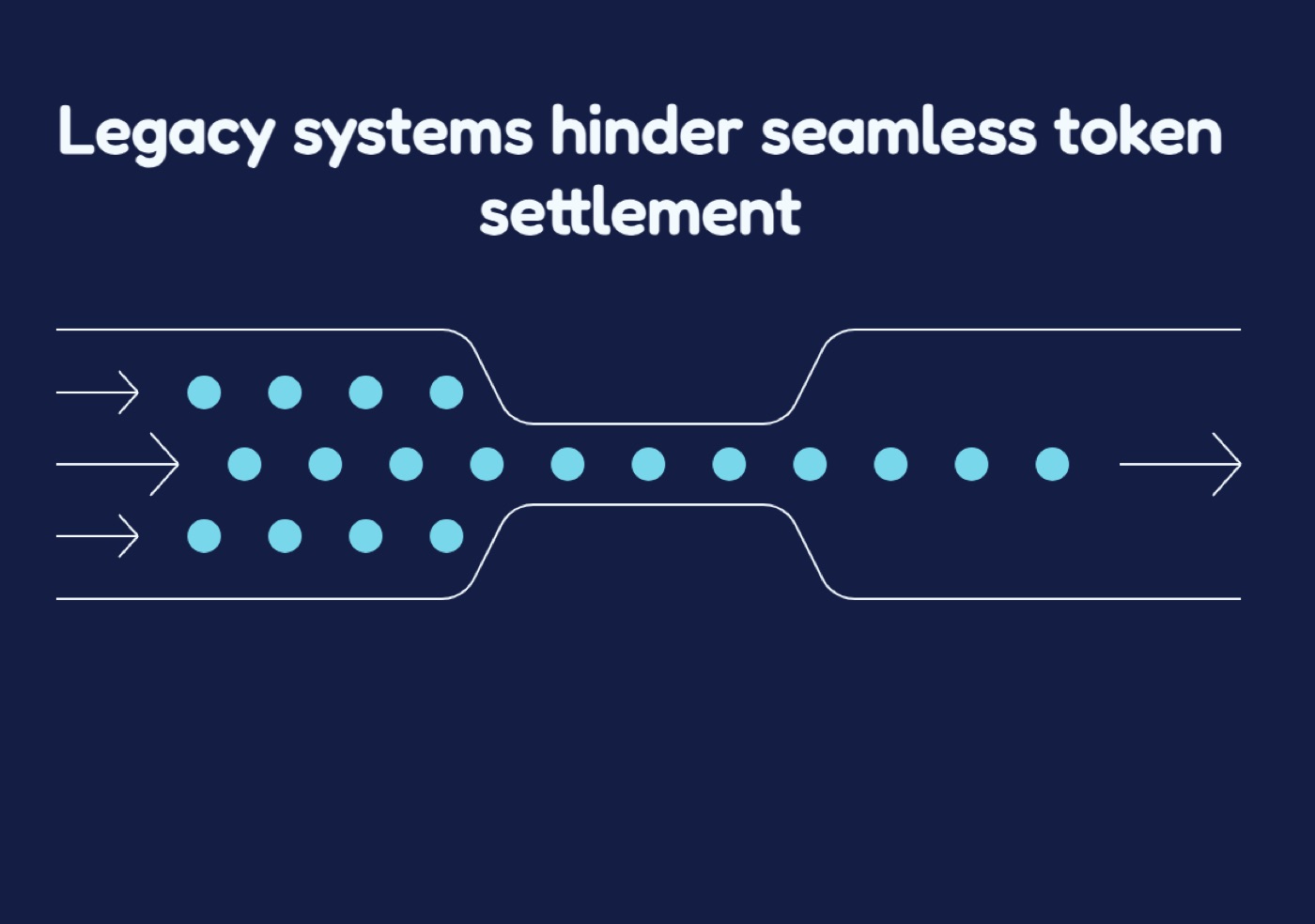
The blocker isn’t technical capability. It’s interoperability. A bank can issue a tokenized asset on a private ledger, but if the settlement leg requires a manual reconciliation with a legacy payment system, the benefit of tokenization disappears. For a pilot, that workaround is acceptable. For production, it’s a dealbreaker.
Institutional Custody Requires More Than a Vault
Qualified custodians like BNY Mellon and State Street are actively building digital asset custody solutions. They understand the need for segregation of assets, bankruptcy remoteness, and auditable controls. Yet regulatory clarity remains incomplete, and that uncertainty keeps banks in pilot mode.
The SEC’s Staff Accounting Bulletin No. 121 (SAB 121), issued in 2022, created a significant accounting hurdle by requiring banks that custody crypto assets to record a liability equal to the fair value of those assets on their balance sheets. For tokenized securities, the situation is more nuanced—but the precedent has made legal and compliance teams cautious. The SEC rescinded SAB 121 in January 2025 with SAB 122, but the episode left banks cautious, and custody rules for tokenized assets are still being settled.
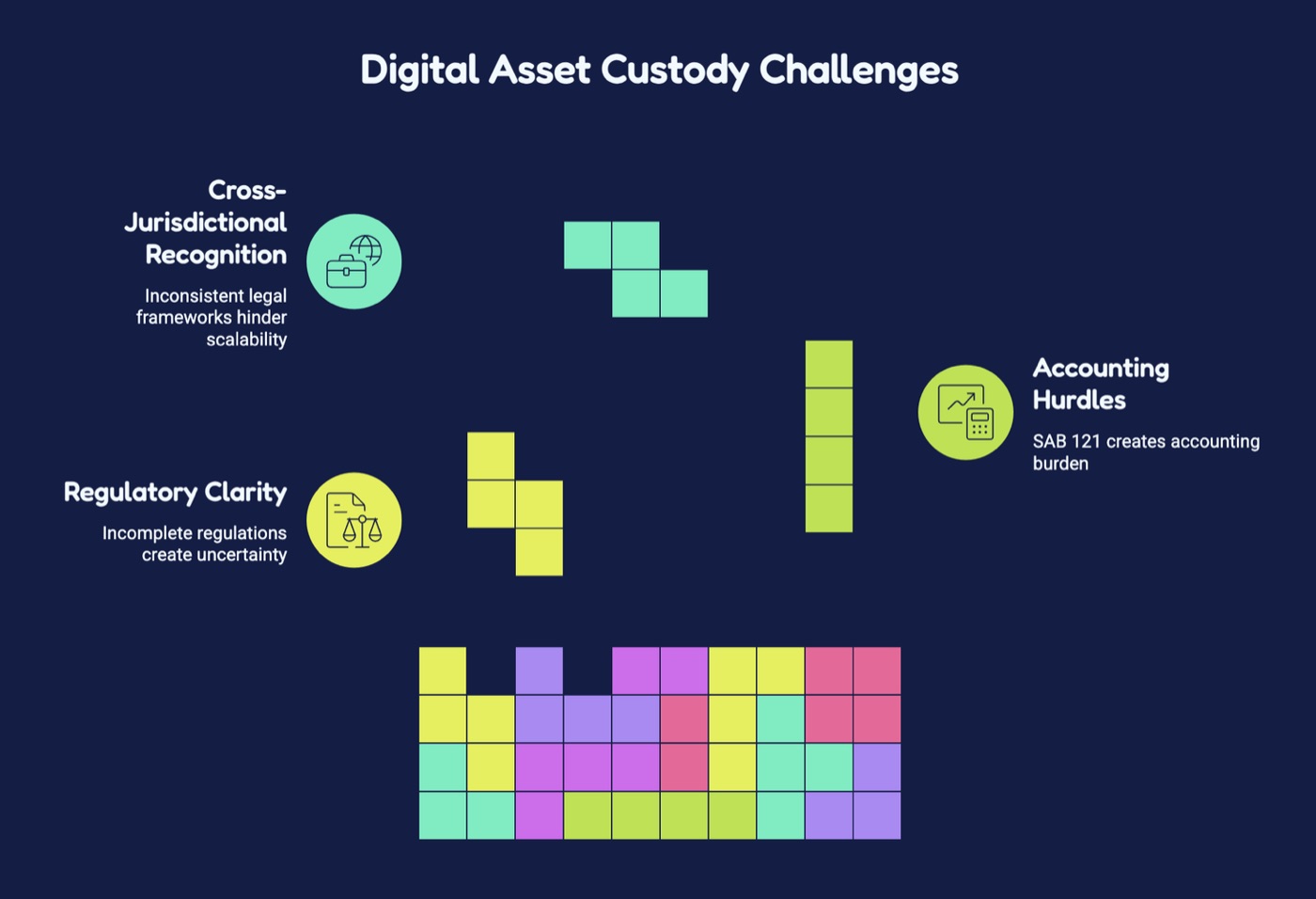
Cross-jurisdictional recognition is another gap. A tokenized real estate asset issued in the UAE needs to be recognized as valid collateral by a bank in Singapore and a custodian in London. Without consistent legal frameworks across jurisdictions, custody remains a patchwork of bilateral agreements rather than a scalable infrastructure. In a pilot, you can negotiate those agreements by hand. In production, you need a standard.
Programmable Compliance Must Operate in Real Time
Anti-money laundering (AML) and know-your-customer (KYC) obligations don’t stop at the token boundary. When a tokenized security moves from one wallet to another—even within a permissioned network—the bank must still verify the identity of the sender and receiver, screen against sanctions lists, and ensure compliance with the FATF Travel Rule.
The Travel Rule, originally designed for wire transfers, now applies to virtual asset transfers, including tokenized securities. But implementation varies widely by jurisdiction. The UAE, for example, has aligned its virtual asset regulations with FATF recommendations, while other markets are still drafting rules. A token that complies with UAE regulations may not satisfy Singaporean or EU requirements.
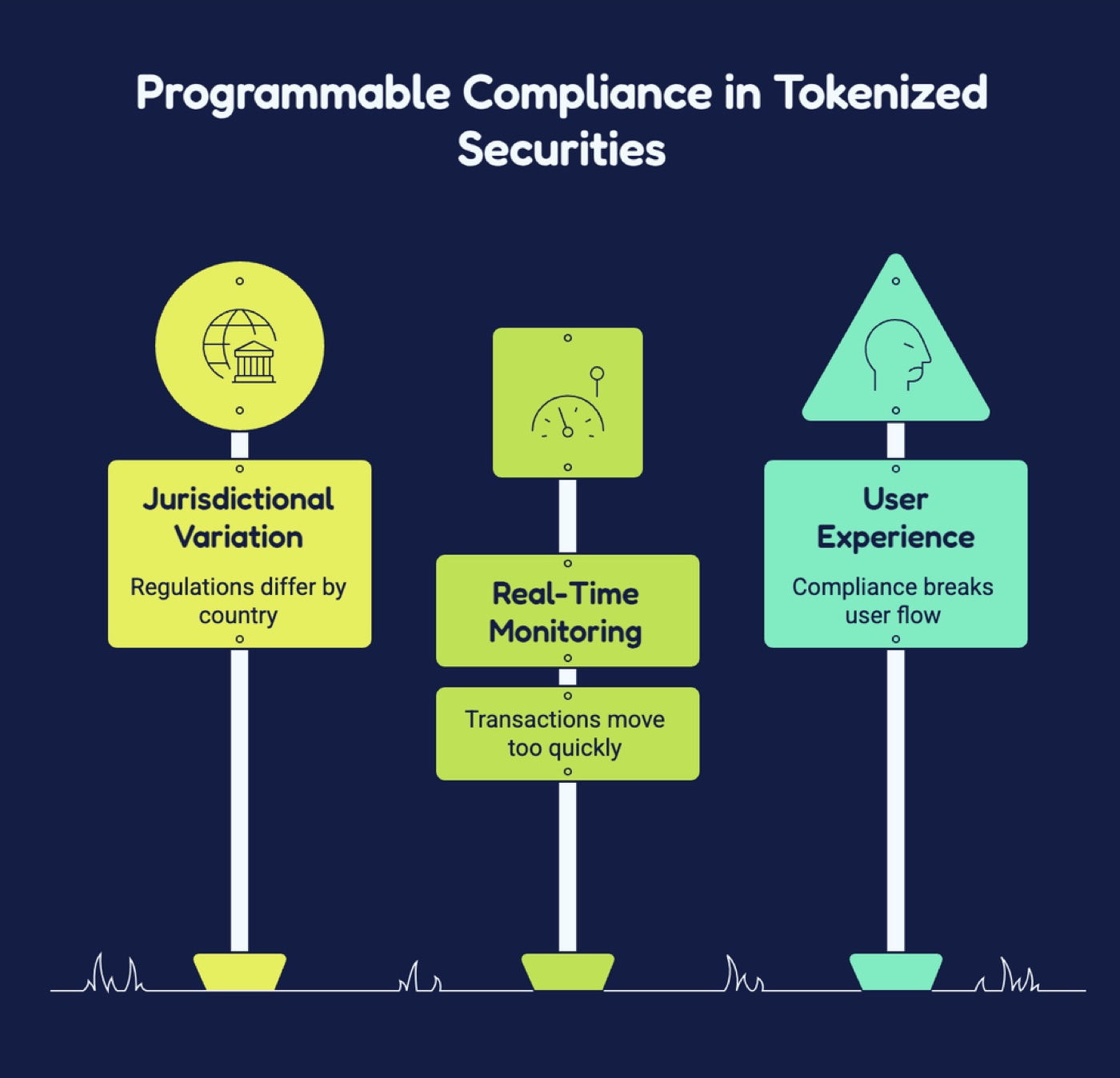
Real-time transaction monitoring across DLT networks adds another layer of complexity. Unlike traditional banking, where transactions settle in batches and can be manually reviewed, tokenized assets often move in seconds. Banks need automated compliance engines that can screen, block, or flag transfers instantly—without breaking the user experience. Many pilots sidestep this challenge by limiting transfers to a closed group of pre-vetted participants. In production, that limitation defeats the purpose of tokenization.
The Production Threshold: One Infrastructure, Not Three
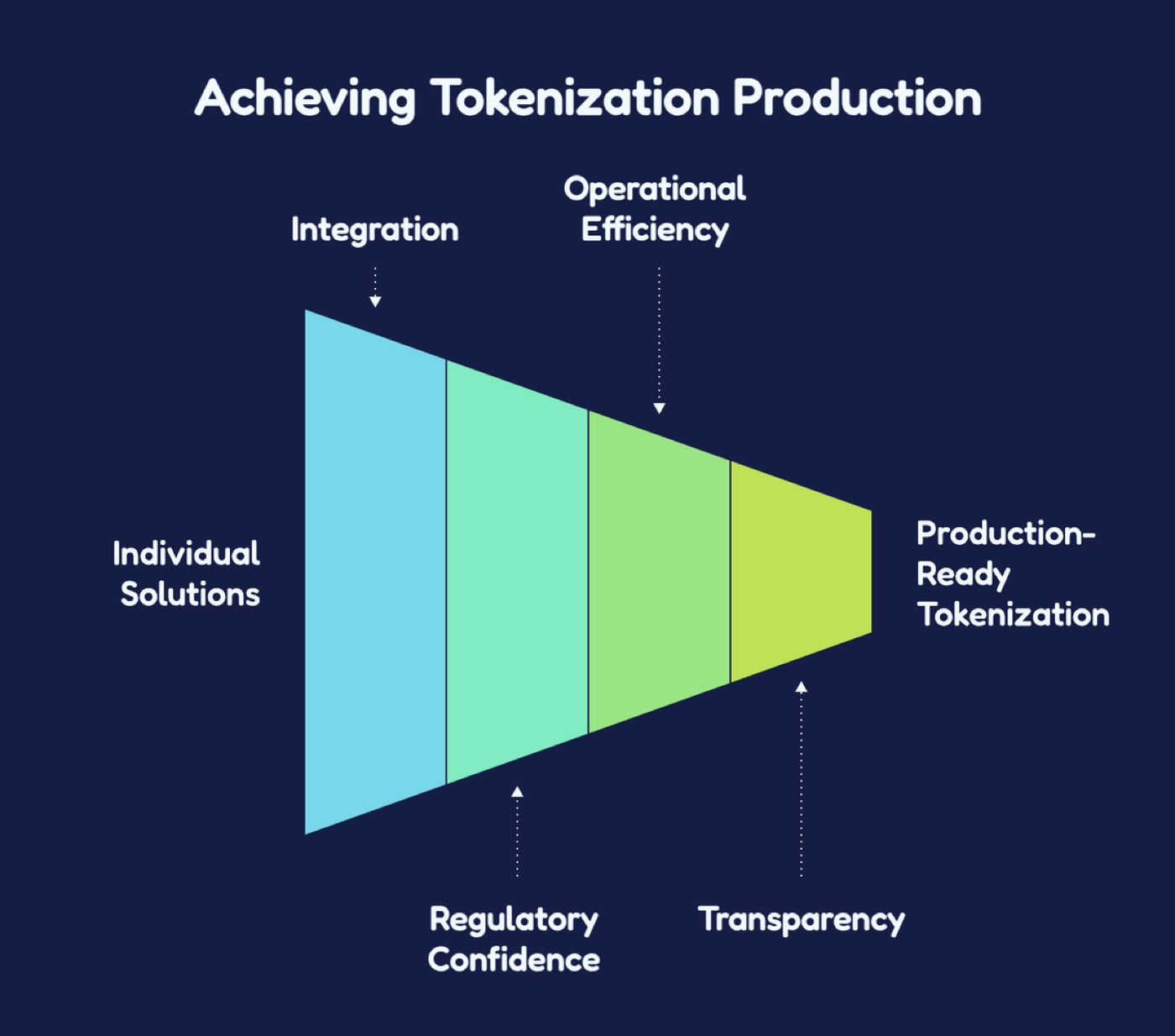
Each of these challenges—payments, custody, compliance—can be solved individually. The real production threshold is when they operate as a single, integrated infrastructure. That means a tokenized asset can be issued, settled, custodied, and transferred across jurisdictions with the same regulatory confidence and operational efficiency as a traditional security—but faster, cheaper, and more transparent.
Banks that are serious about moving from pilot to production need to think infrastructure-first. Not “we’ll launch the token and figure out the rest later.” The smart contract is the easy part. The harder, more valuable work is connecting the token to real payments, qualified custody, and programmable compliance in a way that satisfies regulators in every market where the asset will trade.
Further reading: VARA inspection readiness · Supervisors want evidence, not policies