Trading Tokenized Real Estate: Venues, Risk and Settlement
How to run a market in tokenized real estate: order books vs RFQ, OTC and auctions, matching engines, pricing illiquid tokens, pre-trade risk and settlement.

Tokenizing a property is the easy part. Running a market in it is harder: real estate tokens trade rarely, in uneven sizes and without a continuous price. This guide covers the trading layer an institutional platform needs, from choosing the right venue for each trade to the matching engine, pricing for illiquid assets, pre-trade risk checks and settlement, and how each piece hands off to the next.
Choosing the right venue for each trade
Not every asset wants to trade like a stock.
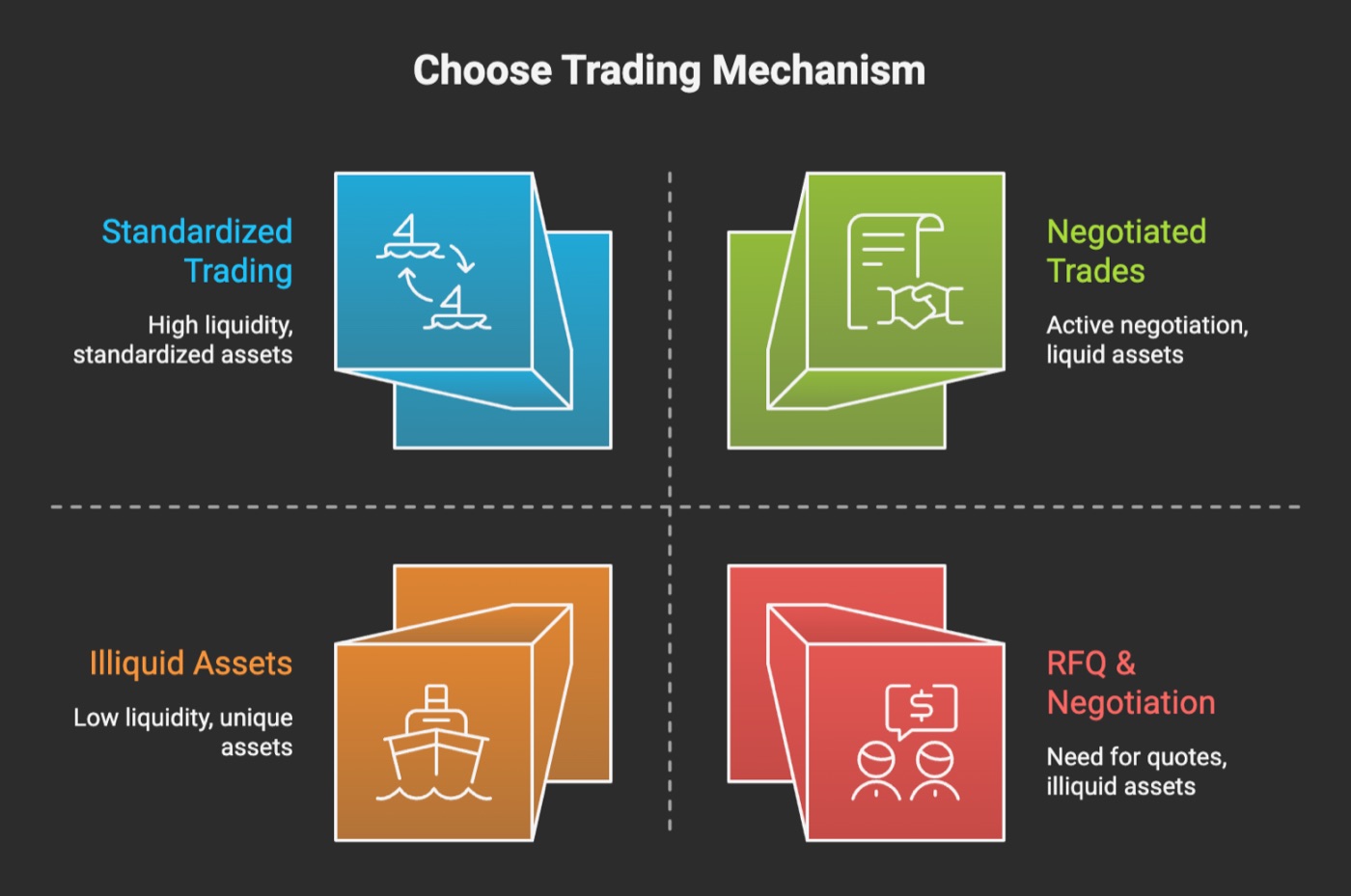
Real estate tokens and many other alternative assets don’t behave like listed equities. Liquidity is patchy. Sizes vary. Prices are often discovered through negotiation, not a ticker. So the right question isn’t “do we need an order book?” but “which mechanism fits this asset and this trade?” Here’s a concise guide.
The Order Book
An order book is a continuous, visible list of buy and sell orders. Trades happen when orders match by price (and often by time). It works best for liquid, standardized products with enough flow to keep the book filled. For real estate tokens and similar assets, that’s often the exception, not the rule.
The RFQ
Request-for-Quote flips the model. One side requests a quote (size, asset, sometimes direction); others respond with prices. The requester picks a quote or negotiates. RFQ is built for size and illiquidity—when you need to find a counterparty and agree on a price instead of hitting a passive order. It’s standard in fixed income and many alternative markets; it fits tokenized real estate the same way.
OTC and bilateral negotiation
Sometimes two parties need to agree on price and terms entirely off-book. OTC workflows support that: lifecycle (request, negotiate, agree, execute), status tracking, and audit trail. The platform doesn’t set the price; it facilitates the negotiation and then records the trade for settlement and compliance. For bespoke or large trades, OTC is the natural complement to RFQ and the order book.
Auctions (Dutch vs English)
When you have one asset or one block and multiple interested parties, auctions solve price discovery. In an English auction, price goes up until one bidder remains. In a Dutch auction, price descends until someone takes the size. Both are used for block trades and one-off sales. Tokenization makes it easier to run these digitally and settle into the same registry and custody as the rest of the platform.
Takeaway
The core takeaway is simple: Liquidity isn't one-size-fits-all. Stop trying to force alternative assets like real estate tokens to trade like high-volume tech stocks. Instead of a "one-market-fits-all" approach, successful platforms use a multi-tool strategy:
- Standardized & Liquid? Use an Order Book.
- Large & Illiquid? Use RFQ.
- Bespoke & Private? Use OTC.
- High Demand & One-off? Use an Auction.
Secondary markets for illiquid assets
The biggest opportunity in tokenization isn’t issuance—it’s trading what’s already issued.
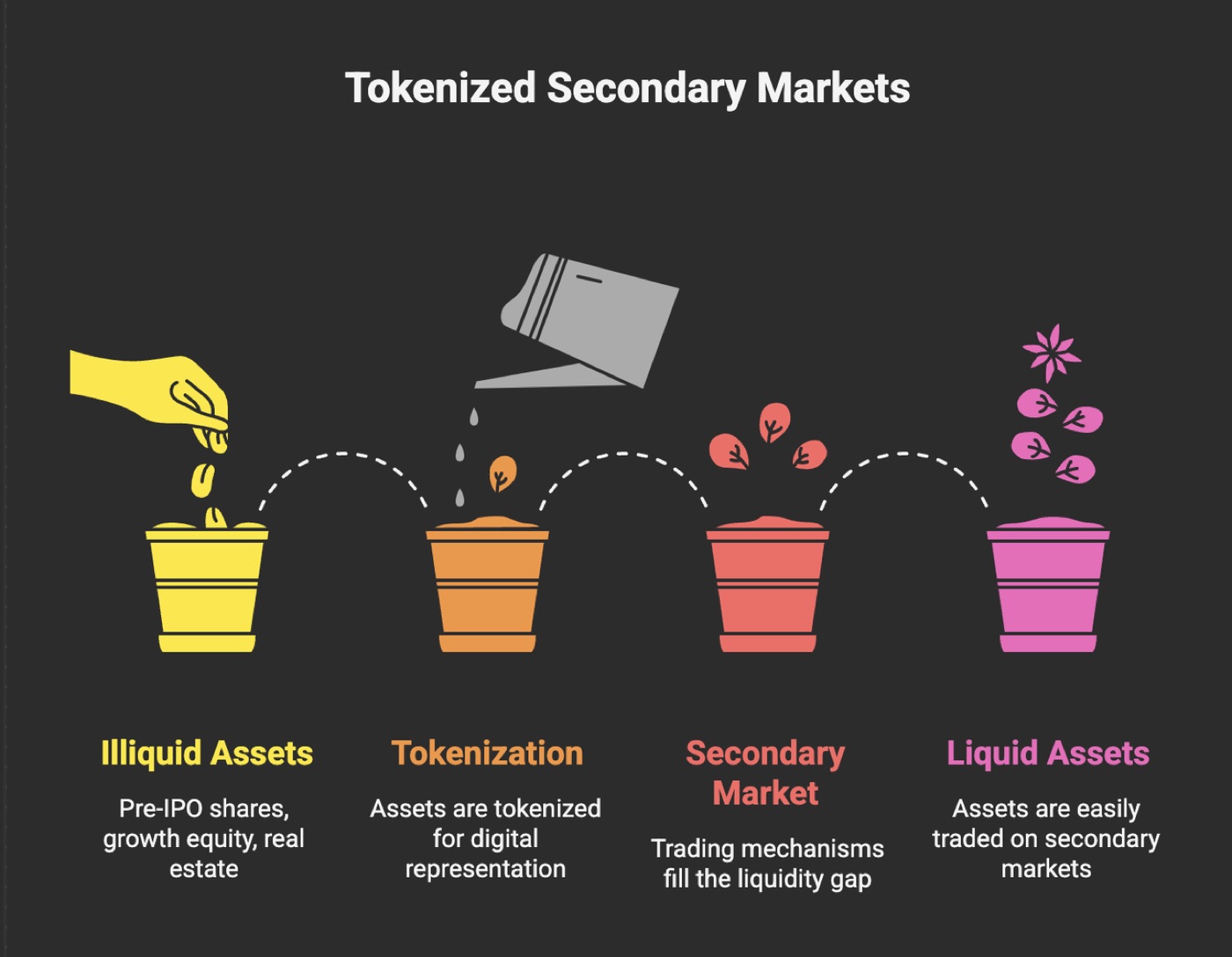
Primary markets get the headlines. But once assets are tokenized, the real unlock is secondary liquidity. Pre-IPO shares, growth equity, real estate tokens, and fund interests are often stuck in a liquidity gap: too big or too rare for a continuous order book, but too valuable to leave completely illiquid. Tokenized secondary markets—with the right trading mechanisms—can fill that gap.
The liquidity gap
Pre-IPO and growth equity, real estate, and many alternative assets don’t trade on an exchange. Order books work when there’s constant two-sided flow and standardized size. For large blocks, negotiated deals, and one-off sales, you need different tools: request-for-quote (RFQ), over-the-counter (OTC) negotiation, and auctions. Tokenization doesn’t fix liquidity by itself; it fixes record-keeping and settlement. The trading mechanism is what creates the market.
What “secondary” means for tokenized assets
Secondary means: same asset, new owner. The registry (who owns what) and custody (where the tokens sit) must update in sync. Transfer restrictions—Rule 144, lock-ups, accreditation—must be enforced at the point of transfer. That’s the job of a transfer agent and the systems that plug into it. Tokenization makes this enforceable in software; it doesn’t remove the need for a cap table of record.
Why alternative trading mechanisms matter
RFQ lets a buyer or seller request a quote; counterparties respond; the best or agreed price wins. OTC supports bilateral negotiation with full lifecycle and audit. Auctions (Dutch or English) bring multiple participants together for price discovery on block trades or one-off sales. You choose the mechanism by asset type, size, and liquidity. One platform can support all of them so issuers and investors aren’t forced into a one-size-fits-all order book.
Use cases
Large block trades in tokenized real estate or equity. Pre-IPO secondaries where employees or early investors want to sell. Illiquid securities that need a structured process to find a price. Real estate token resales and fund interest transfers. In each case, the infrastructure—marketplace (RFQ, OTC, auctions), exchange where relevant, settlement, and custody—has to work together.
Infrastructure that makes it possible
That means marketplace APIs for RFQ, OTC, and auctions; an exchange for order-book trading when it fits; settlement that moves tokens and cash and updates the registry; and custody that holds the tokens and respects transfer restrictions. When all of that is integrated, tokenized secondary markets stop being a concept and become something you can actually use.
The matching engine
The exchange is the most visible part—and the most misunderstood.
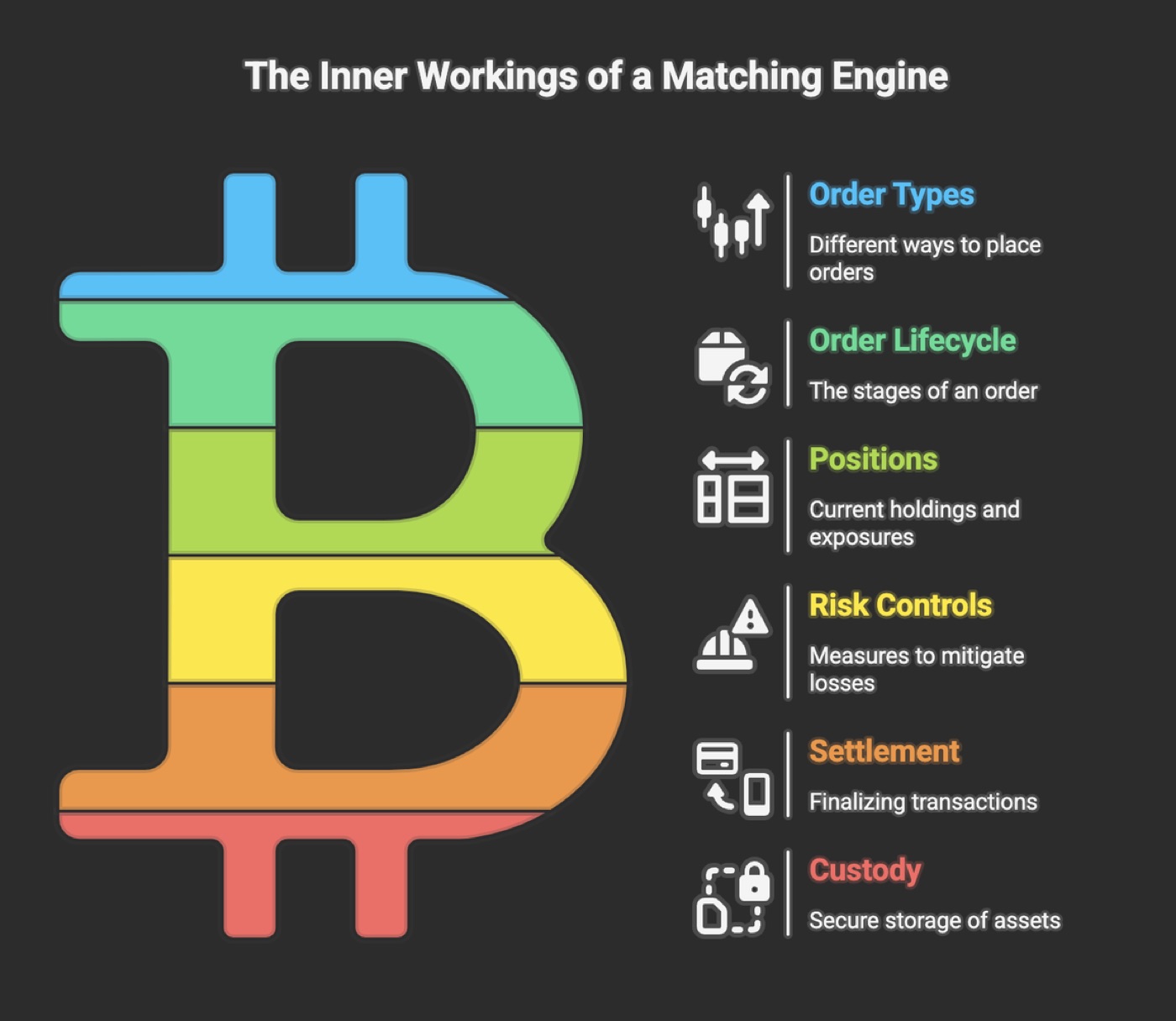
When people think “trading platform,” they picture the order book: bids, asks, and instant execution. What they often miss is how much sits behind it—order types, lifecycle, positions, risk controls, and how it plugs into settlement and custody. Here’s what a matching engine for tokenized assets actually does and why it matters for real estate and beyond.
What a matching engine does
A matching engine takes orders in and produces trades out. It applies a rule (usually price-time priority: best price first, then earliest order) and generates executions. It also needs to handle halts and circuit breakers—stopping the book when something goes wrong or when a corporate action or risk event requires a pause. For tokenized assets, the same engine might serve real estate tokens, fund interests, or other illiquid instruments; the logic is similar, but the liquidity profile is different.
Core concepts
Orders have a type (market, limit, etc.), status (pending, filled, cancelled), and full lifecycle. You place, amend, cancel; the engine tracks state and enforces rules. Trades are the output: who bought, who sold, at what price and size, and when. Positions are the result: each account’s holdings and P&L—realized (closed trades) and unrealized (mark-to-market on open positions). Orders, trades, and positions are the core domain model; APIs that expose them clearly make it possible to build UIs, risk tools, and reporting on top.
Quotes and liquidity
Beyond retail orders, you have quotes—bid/ask from market makers or liquidity providers. Two-sided markets need someone to post size and tighten spreads. Tokenized real estate often doesn’t have continuous two-sided flow, so the exchange might be used for smaller, more liquid tranches while RFQ or OTC handles blocks. The platform should support both: order book where it fits, quotes for liquidity, and clear links to alternative mechanisms when the book isn’t the right tool.
Halts and risk controls
Markets halt for volatility, news, corporate actions, or operational issues. Circuit breakers pause trading when price or volume moves too far. These need to be first-class: halt a market, resume it, and have orders and trades respect the halt. Risk doesn’t stop at the engine—pre-trade checks (position limits, exposure, KYC) should run before an order is accepted. Linking the exchange to a risk-limits domain keeps the book safe and compliant.
API-first design
When the exchange is built as a set of clear domains—orders, trades, positions, quotes, halts—you get an API-first design. Integrators and internal systems can place orders, read trades, and compute P&L without scraping UIs. And because the exchange is only one step in the chain, it has to fit into the broader platform: settlement consumes trades, custody holds the tokens, and the transfer agent knows who owns what. A matching engine that’s designed to plug into that chain is what turns “we have trading” into “we have a full trading and settlement stack.”
Pricing tokens that rarely trade
When there’s no ticker, how do you price?
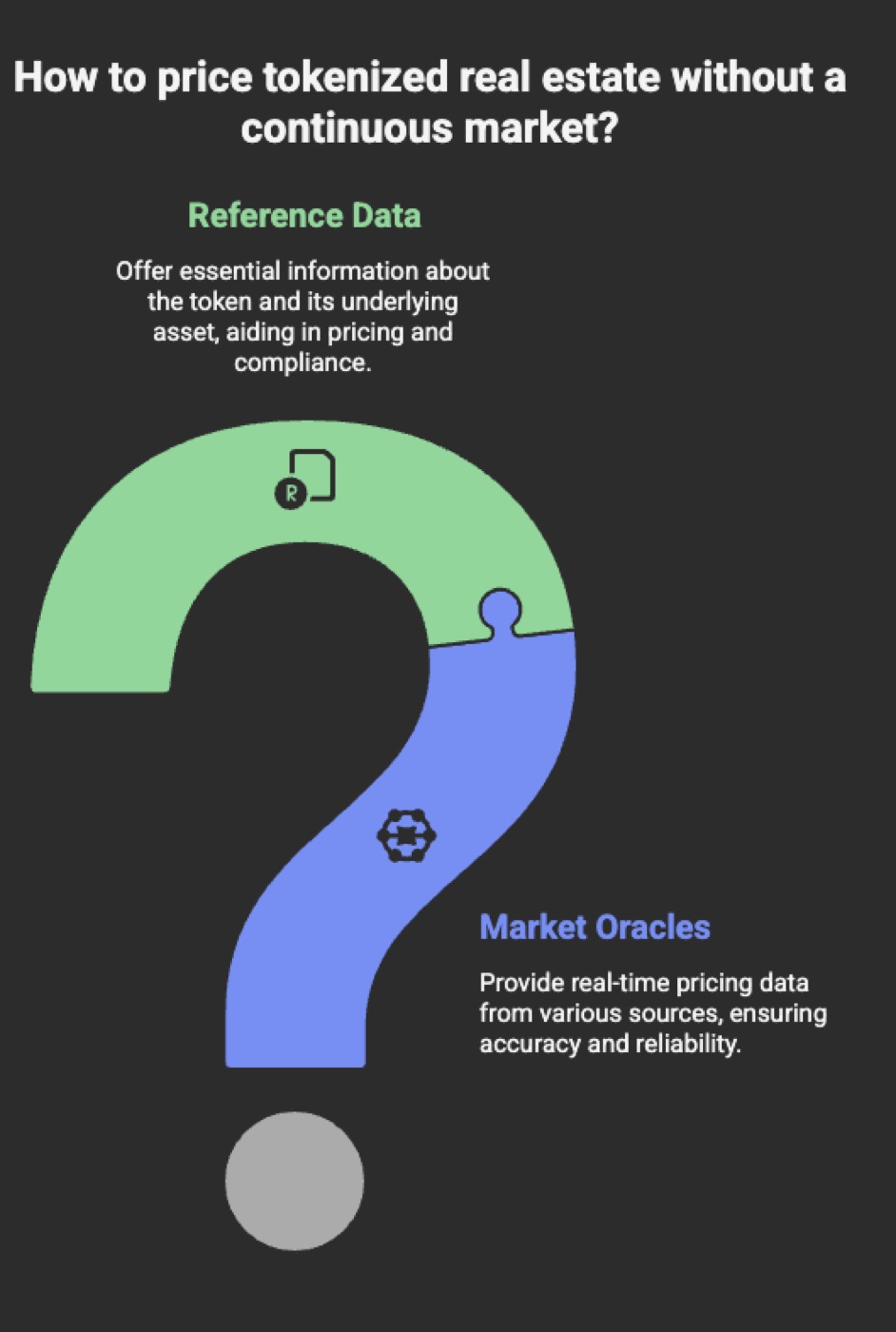
Listed equities have a continuous market and a last price. Tokenized real estate often doesn’t. You need pricing for risk, margin, reporting, and compliance—so you need a way to get it. Market oracles and reference data are the answer: a source of truth for “what is this token?” and “what is it worth?” Here’s how they fit into a tokenization platform.
The pricing challenge
Illiquid assets don’t trade every second. Price comes from appraisals, models, comparables, or NAV (net asset value) from the issuer or administrator. You need a reference price (or a range) for each token or asset, plus reference data (terms, issuer, corporate actions) so that downstream systems know what they’re dealing with. Without that, risk limits, P&L, and reporting are guesswork.
What oracles provide
Oracles (or price/valuation services) provide price feeds and valuations—point-in-time or periodic. Reference data provides assets, issuers, terms, and sometimes corporate actions. Together they are the source of truth for risk (e.g. exposure and concentration), margin (if applicable), and reporting (NAV, performance). The platform doesn’t have to compute price itself; it consumes oracles and ref data and applies them consistently.
Reference data
Reference data answers: “What is this token? Who issued it? What are the terms?” Pricing adds: “What is it worth (and as of when)?” When pricing and ref data are a first-class domain—with APIs for assets, prices, and corporate actions—every other domain (exchange, risk, analytics, compliance) can use the same numbers. One place for “what is this?” and “what is it worth?” avoids duplication and inconsistency.
Use cases
Risk limits: exposure and concentration need current (or stale) prices. P&L: realized and unrealized depend on entry price and mark. Reporting: investor statements and regulatory reports need consistent valuation. Compliance: some rules are price- or value-based. Analytics and dashboards consume the same data for KPIs and trends. When oracles and ref data are in the platform, all of these stay aligned.
Platform role
Market oracles and pricing/ref data are domains in the stack: they expose APIs that exchange, risk, and analytics consume. They don’t replace the valuation methodology (that’s still appraisals, NAV, or third-party feeds)—they make the output of that methodology available in a consistent, auditable way across the platform.
Pre-trade risk checks
The best risk management is the trade that never happens.
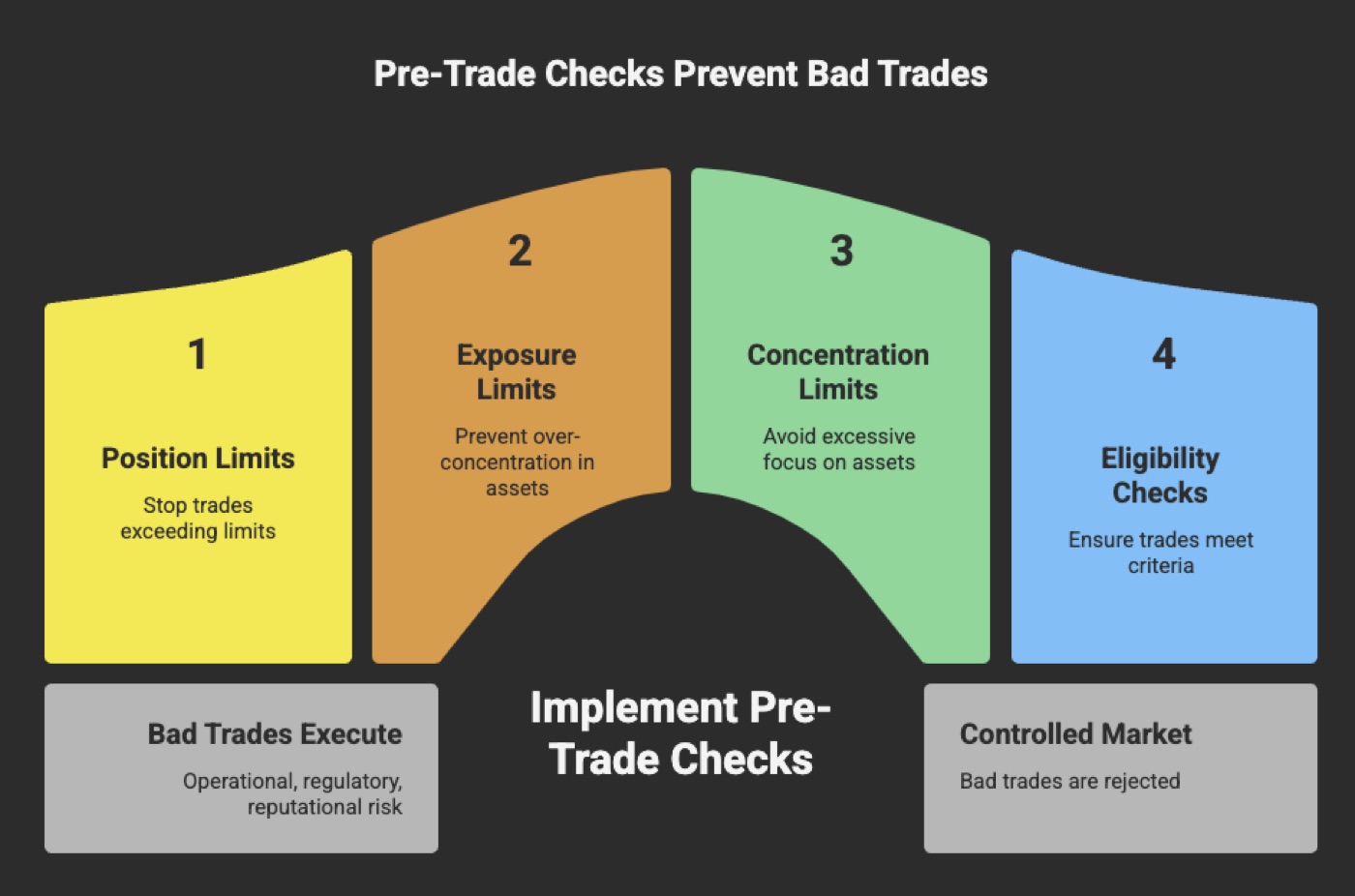
Letting a trade through that violates limits or eligibility creates operational, regulatory, and reputational risk. Pre-trade checks—position limits, exposure, concentration, and eligibility—stop bad trades before they execute. For institutional tokenized assets, that’s not optional. Here’s why pre-trade risk matters and how to design it into the platform.
Why pre-trade risk matters
Position limits (max size per account, org, or asset), exposure limits (total notional, sector, or issuer), and credit or eligibility (KYC, whitelist, transfer restrictions) protect both the platform and the client. Regulatory and internal risk appetite are enforced at the gate: if a trade would breach a limit, it’s rejected. Doing this before execution—not after—is what separates a controlled market from a post-trade mess.
What to check
Checks can be by account, org, asset, or market: e.g. “this account can’t hold more than X in asset Y” or “this org’s total exposure to real estate tokens is capped.” Concentration limits (e.g. max % in one asset or issuer) and eligibility (KYC approved, whitelisted for this token, no transfer restriction blocking the trade) belong in the same framework. A risk limits API lets you define, update, and evaluate these rules so that they’re consistent and auditable.
Where to enforce
Enforcement has to happen at every entry point: exchange (order acceptance), marketplace (RFQ/OTC/auction), and settlement (before finalizing a trade). If any path can bypass the checks, the limits are meaningless. Fail fast with clear messaging: “Order rejected: position limit exceeded” so that traders and systems can react. The same limits and the same engine should back all venues so that behavior is predictable.
Design
A risk limits API supports: defining limits (by account, org, asset, market, or custom scope), updating them (with approval/audit if required), and evaluating a proposed action (e.g. “would this order breach any limit?”). Consistency across order types and venues—limit, market, RFQ, OTC—means one place to configure and one place to audit. That’s how you keep risk under control as the product set grows.
Institutional requirement
Funds and institutions demand configurable limits and a clear audit trail. They need to show regulators and allocators that risk is controlled and that breaches are prevented, not just reported. Pre-trade checks and a dedicated risk-limits domain are table stakes for institutional adoption of tokenized assets.
Settlement and netting
A trade isn’t done when it’s matched—it’s done when it’s settled.
Execution is step one. Settlement is where tokens and cash actually move, and where the registry and custody get updated. Get settlement wrong, and you get failed trades, reconciliation nightmares, and compliance gaps. Get it right, and you have a clear, auditable path from trade to ownership. Here’s what settlement means for tokenized real estate and how netting and failure handling fit in.
What settlement means
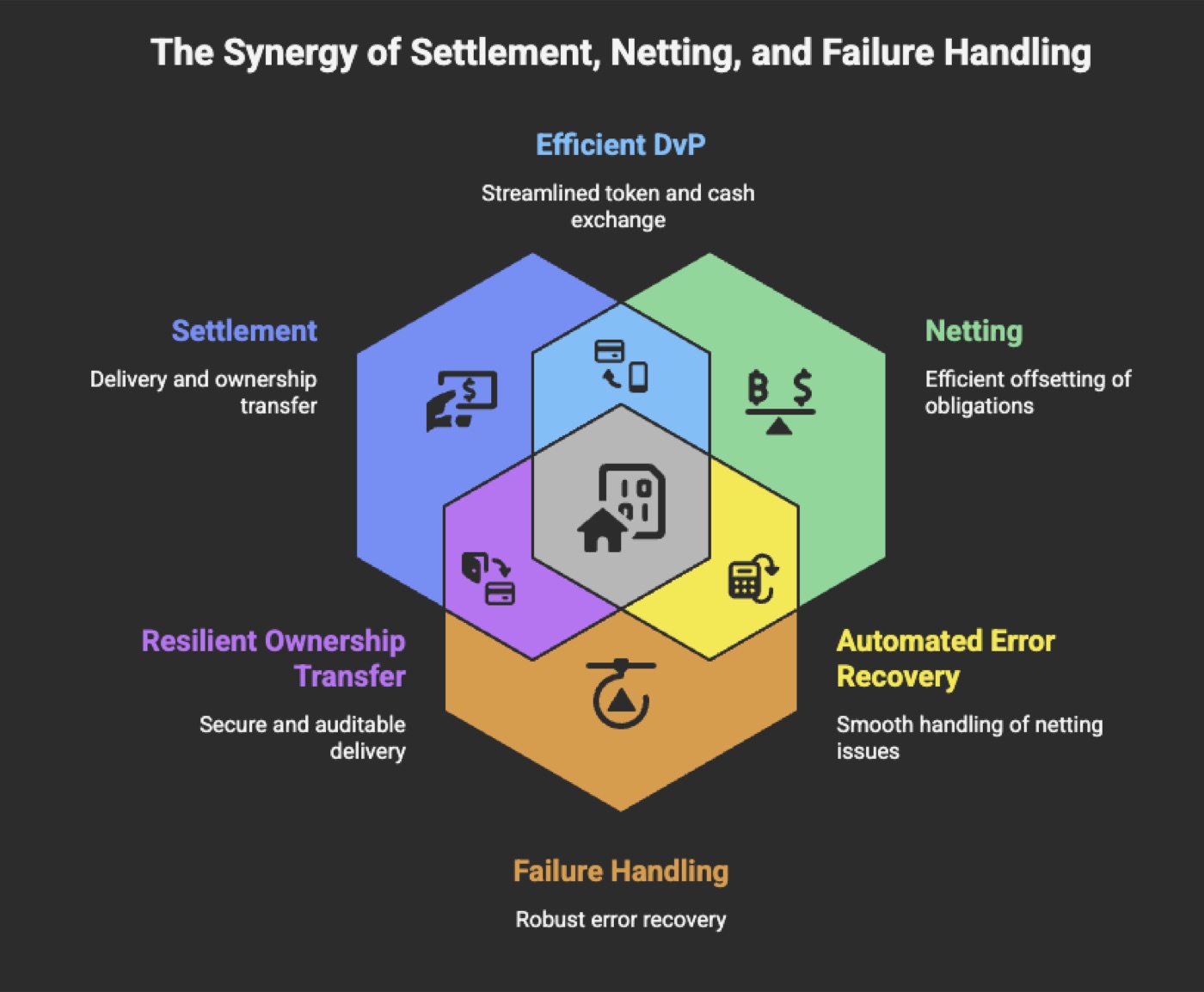
Settlement is delivery versus payment (DvP): one side delivers tokens, the other delivers cash (or another asset), and both happen in a coordinated way. T+0 means same-day settlement; T+1 means next day. For tokenized assets, T+0 is often achievable because the registry and custody can be updated in real time—but you still need a defined process, idempotency, and failure handling so that “settled” means “actually settled,” not “we think so.”
Settlement failures and retries
Trades fail for many reasons: insufficient balance in custody, a failed compliance or transfer-restriction check, or a downstream system timeout. So settlement must support retries, partial settlement (e.g. fill what you can, fail the rest), and failure handling—clear statuses and alerts so ops can fix and retry. A settlement API that exposes status, supports idempotent retries, and logs every attempt is what turns a failed trade into a recoverable workflow instead of a manual mess.
Netting
Netting reduces gross flows to net positions. Instead of A sending 100 to B and B sending 50 to A, you settle 50 from A to B. That cuts movement, lowers operational risk, and can reduce liquidity needs. For tokenized real estate, where trading might be less frequent, netting still matters for platforms that aggregate many participants or run batch settlement. Design the settlement layer with netting in mind so you’re not moving tokens and cash unnecessarily.
How this ties to custody and registry
Settlement doesn’t live in a vacuum. It updates custody (balances, movements) and the transfer agent (registry of record). Whoever owns the token after settlement must be reflected in both places; otherwise you get breaks between “what the exchange says” and “what the cap table says.” A single flow—trade → settlement → custody + registry update—with one identity and one audit trail is the goal. That’s when settlement becomes the bridge that makes the whole chain coherent.
Design principles
Idempotency: retrying the same settlement shouldn’t double-move assets. Audit trail: every attempt and outcome should be logged. Reconciliation hooks: settlement should emit or support events that downstream systems use to reconcile. When those principles are baked in, settlement is reliable, debuggable, and ready for institutional use.
Putting it together
A single trade passes through every layer above. The venue (order book, RFQ, OTC or auction) agrees the price. Pre-trade checks confirm the buyer is eligible and within limits. The pricing service supplies the reference value used for risk and reporting. Settlement then moves tokens and cash and updates custody and the registry. A weakness in any one layer shows up as failed trades or reconciliation breaks in the others, which is why they are best designed together.
Further reading: VARA inspection readiness · Supervisors want evidence, not policies