Structuring Tokenized Real Estate: From SPV to Operations
Beyond the smart contract: SPV and token class design, corporate actions on a digital cap table, fiat and treasury rails, APIs and investor reporting.

A smart contract can mint and transfer a token, but it is a small part of a working tokenized real estate business. The rest is structure and operations: the SPV that owns the property, the token classes and the offering, corporate actions on the register, the fiat rails that move real money, the APIs that connect administrators and banks, and the reporting investors expect. This guide walks through each.
Why the smart contract is the small part
The contract is 10% of the solution.
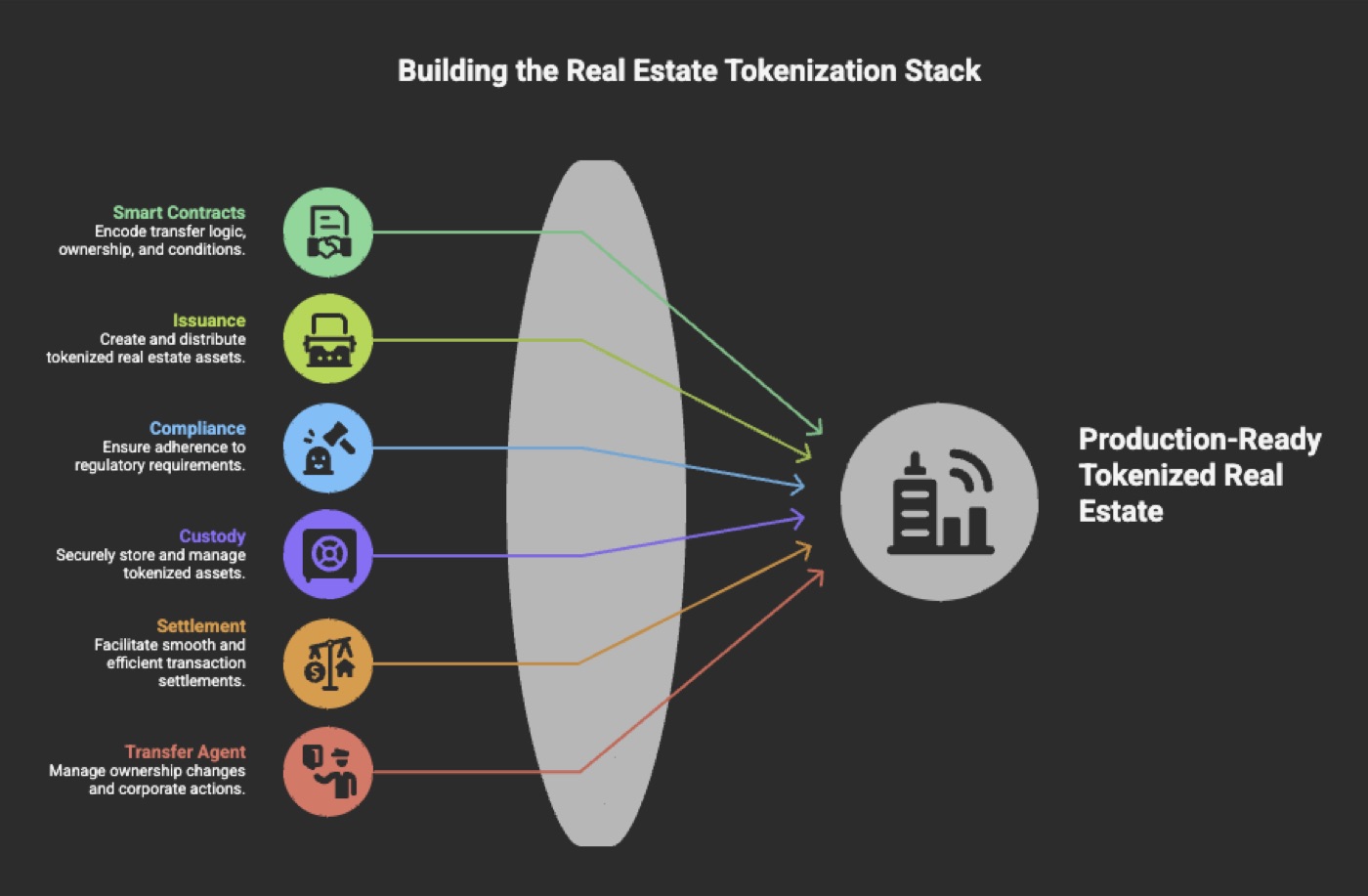
Smart contracts get the buzz. They can encode transfer logic, ownership, and conditions. But tokenized real estate that’s ready for institutions and regulation needs a full stack: issuance, compliance, custody, settlement, transfer agent, corporate actions, fiat rails, and identity. The contract is one piece. Here’s what’s missing when you stop at the chain—and what “production-ready” actually means.
What smart contracts do well
Smart contracts excel at transfer logic (move tokens from A to B), ownership (who holds what on-chain), and conditions (release escrow when X is true). They’re transparent and programmable. For pure crypto-native assets, that can be enough. For securities and real estate, regulation and operations live largely off-chain. The contract can’t do KYC, run the cap table, or move fiat. So the contract is necessary—but not sufficient.
What’s missing
Issuance: primary market—projects, offerings, subscriptions, milestones—is where assets are created and sold. That’s workflows, eligibility, and escrow, not just a mint. Compliance: KYC, accreditation, and whitelist enforcement happen before and around the chain. Custody: who holds keys, qualified vs self-custody, attestations—all of that is infrastructure. Settlement: matching trades to movements of tokens and cash, netting, failure handling. Transfer agent: registry of record, restrictions (Rule 144, lock-ups), corporate actions. Fiat rails: deposits, withdrawals, treasury. Identity: who can do what, API keys, audit trail. None of that is “in the contract.” It’s in the platform.
The full stack
A full stack for tokenized real estate looks like: identity (IAM, tenancy, API keys) → primary market (projects, offerings, subscriptions, milestones) → marketplace (RFQ, OTC, auctions) and exchange (orders, trades, positions) → settlement → custody → compliance (KYC, accreditation, whitelist) → transfer agent (registry, restrictions, corporate actions) → treasury, escrow, fiat banking → oracles and risk limits → analytics and reporting. The contract might sit in the middle for on-chain settlement or representation—but the rest is what makes it institutional-grade.
Why it matters for institutions
Institutions care about audit (who did what, when), liability (who’s responsible if something breaks), and regulation (KYC, custody, transfer restrictions, reporting). Those live off-chain. Contract + infrastructure = production-ready. Building only the contract leaves you with a demo. Building the full stack is what gets you allocators and regulators in the room.
Building for the long term
Think platform, not just product. APIs and domains that compose—primary market, marketplace, exchange, custody, compliance, transfer agent—let you add assets, jurisdictions, and partners without rewiring everything. The contract is a component. The platform is what scales.
From SPV to token
The SPV isn’t going away—it’s getting a digital layer.
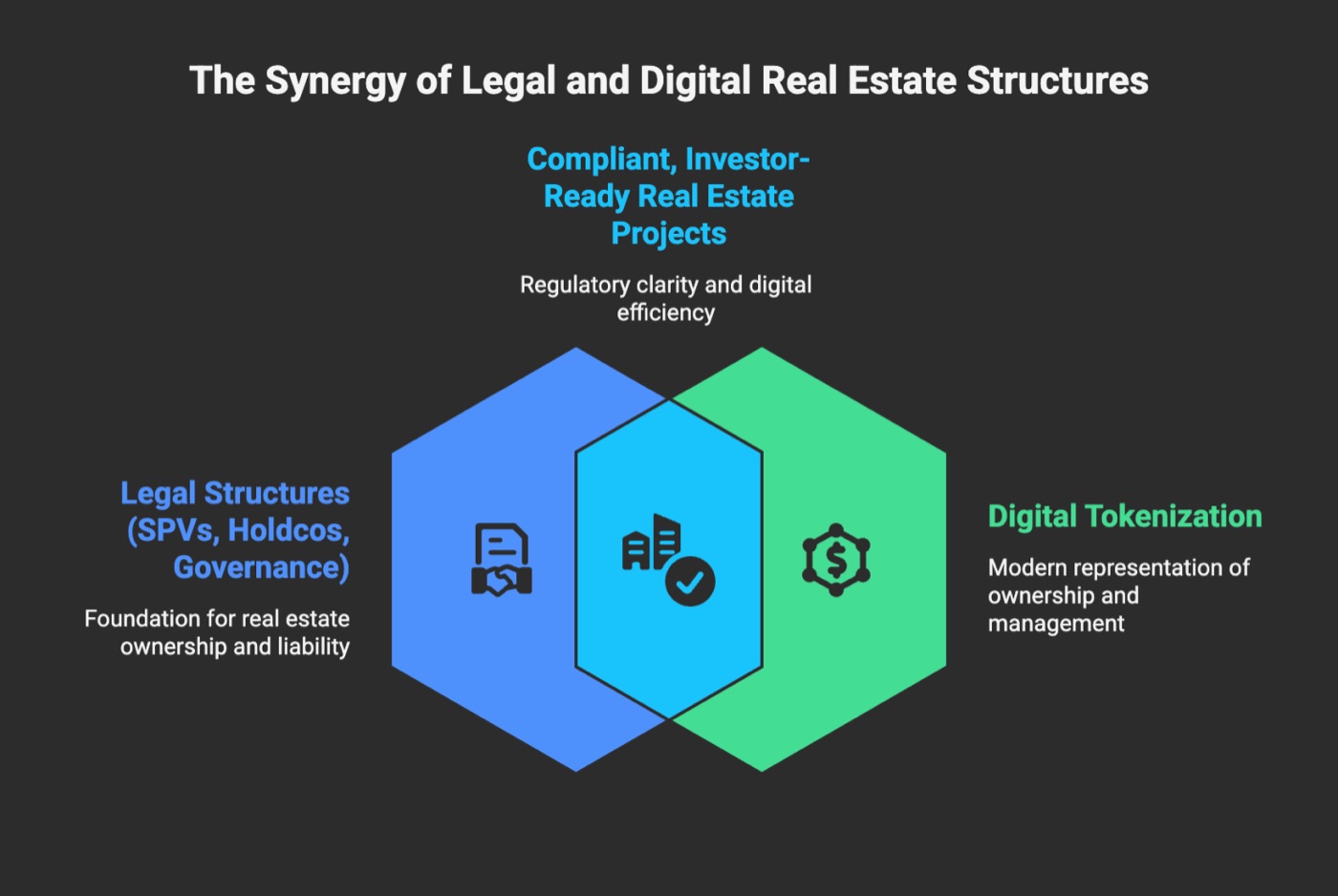
Tokenization doesn’t replace legal structure. It sits on top of it. Special purpose vehicles (SPVs), holdcos, and proper governance are still the foundation. What changes is how we represent ownership, run subscriptions, and manage the cap table. Here’s how to think about structuring tokenized real estate projects so they’re ready for both regulators and investors.
Why structure still matters
SPVs and similar structures exist for good reasons: liability, tax, and regulatory clarity. A token is a representation of an interest in that structure—not a replacement. So you still need one project (or vehicle) that maps to the real-world entity, and one or more token classes that represent the types of interests (e.g. equity, preferred, debt, revenue share). Structure first; tokens second.
Project setup in a tokenization platform
In a tokenization platform, “project” is the digital twin of your deal. It has a type, governance rules, and a link to the SPV or org that owns the asset. Project setup defines what can be issued, who can create offerings, and how milestones (if any) are defined. Getting this right means your platform knows what each token class represents and how it ties back to the legal entity.
Token class definitions
A token class answers: what does this token represent? Equity in the SPV? A revenue share? Debt? Parameters like voting rights, distribution waterfalls, and transfer restrictions belong here. These choices drive compliance (e.g. accredited-only, jurisdiction limits) and how the token will behave in primary and secondary markets. Clear definitions make KYC, transfer agent, and corporate actions much easier later.
Governance and lifecycle
Who can create offerings? Approve milestones? Update the cap table? Governance should be explicit: roles, permissions, and handoffs. Once subscriptions are closed and tokens are issued, the transfer agent takes over as the registry of record—enforcing
restrictions, processing corporate actions, and feeding custody and settlement. The primary market sets the stage; the transfer agent and custody run the ongoing lifecycle.
Practical checklist
Before you go live: legal and tax structure (SPV, jurisdiction), token class design (rights, restrictions), platform capabilities (projects, offerings, subscriptions, milestones), and a clear path to custody and transfer agent. Platforms that support the full primary-market scope—projects, token classes, offerings, subscriptions—give you one place to configure and run the deal.
Corporate actions on the register
Splits, dividends, and reporting—when the cap table is digital.
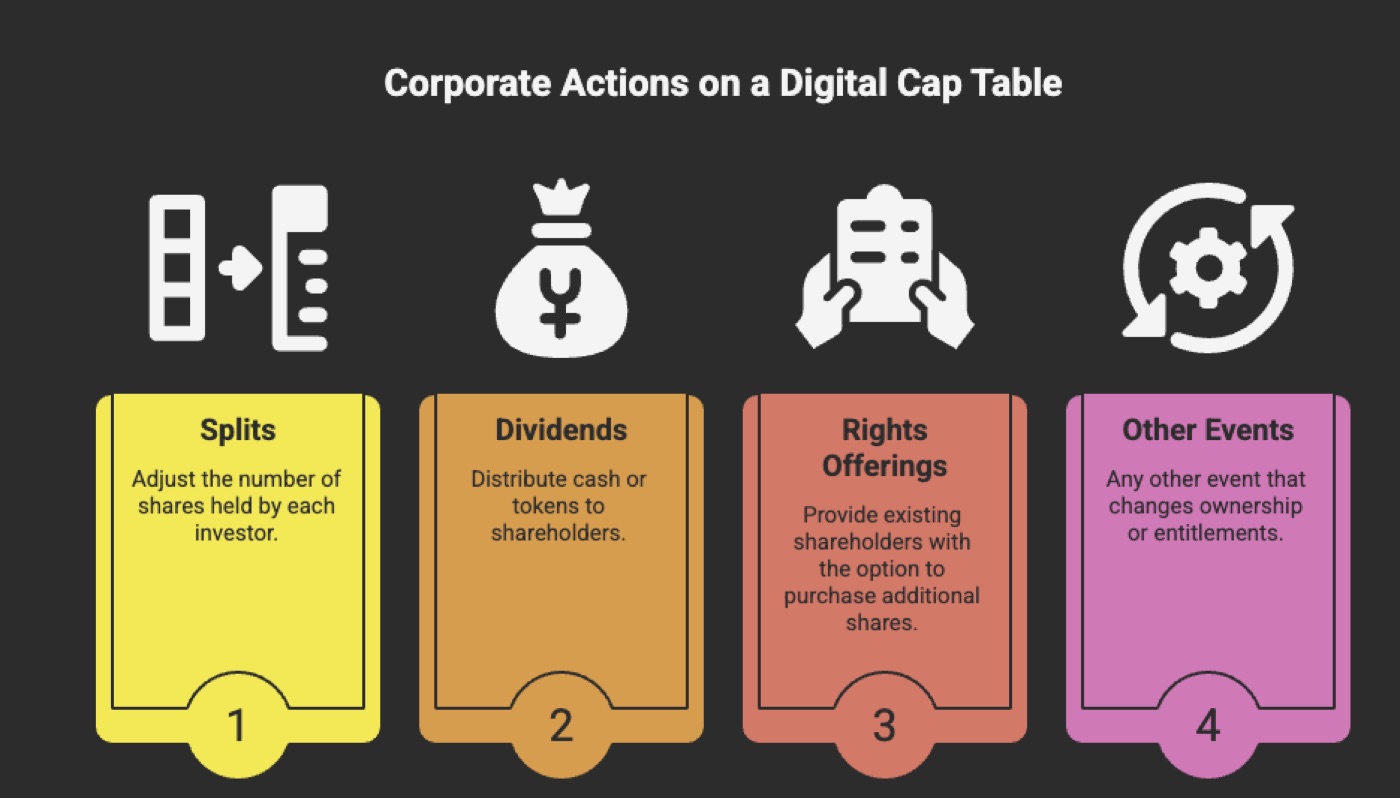
Tokenized securities don’t stop at issuance and trading. Corporate actions—splits, dividends, rights offerings, and other events that change ownership or entitlements—must be processed on the same cap table that tracks who holds what. When the registry is digital and linked to custody and settlement, corporate actions become a platform capability, not a manual back office. Here’s what that looks like and why a single registry matters.
What corporate actions are
Corporate actions are events that affect holders: stock splits (adjust quantity), dividends (distribute cash or tokens), rights offerings (option to subscribe), and similar. Each action has an announcement date, a record date (who’s on the cap table at that time), and a processing date (when positions and payments are updated). The transfer agent (or equivalent) is responsible for running these in line with the issuer’s decisions and regulatory requirements.
Why a single registry matters
If “who owns what” lives in more than one place—e.g. a spreadsheet, a blockchain, and a custodian—you get reconciliation nightmares and errors. A single cap table of record (the transfer agent / registry) means one source of truth. Corporate actions are announced, validated, and processed against that registry; custody and settlement are updated from the same data. No “registry vs blockchain” drift.
Processing flow
The flow is: announce (action type, dates, parameters) → validate (eligibility, positions, restrictions) → process (update positions, trigger distributions, update custody). The transfer agent drives the process; custody and treasury (or fiat banking) handle the actual movement of cash or tokens. When this is API-driven, corporate actions become repeatable and auditable instead of one-off ops tasks.
Compliance and regulation
Corporate actions sit in a regulated space. SEC Rule 17Ad-10 (prompt posting), Regulation S-T (electronic filing), and state Blue Sky requirements apply. Annual shareholder reporting and other disclosures depend on an accurate registry. A platform that supports corporate actions isn’t just moving data—it’s helping issuers meet those obligations with a clear audit trail.
Tokenized real estate
For tokenized real estate, distributions from rental income or capital events are corporate actions: the issuer declares a distribution, the registry has the holder list, and the platform pays out per position. Same logic as dividends on equity—just token-native. When the cap table is digital and integrated with custody and payments, distributions scale without manual spreadsheets.
Treasury and fiat rails
Money doesn’t start on-chain—it arrives there.
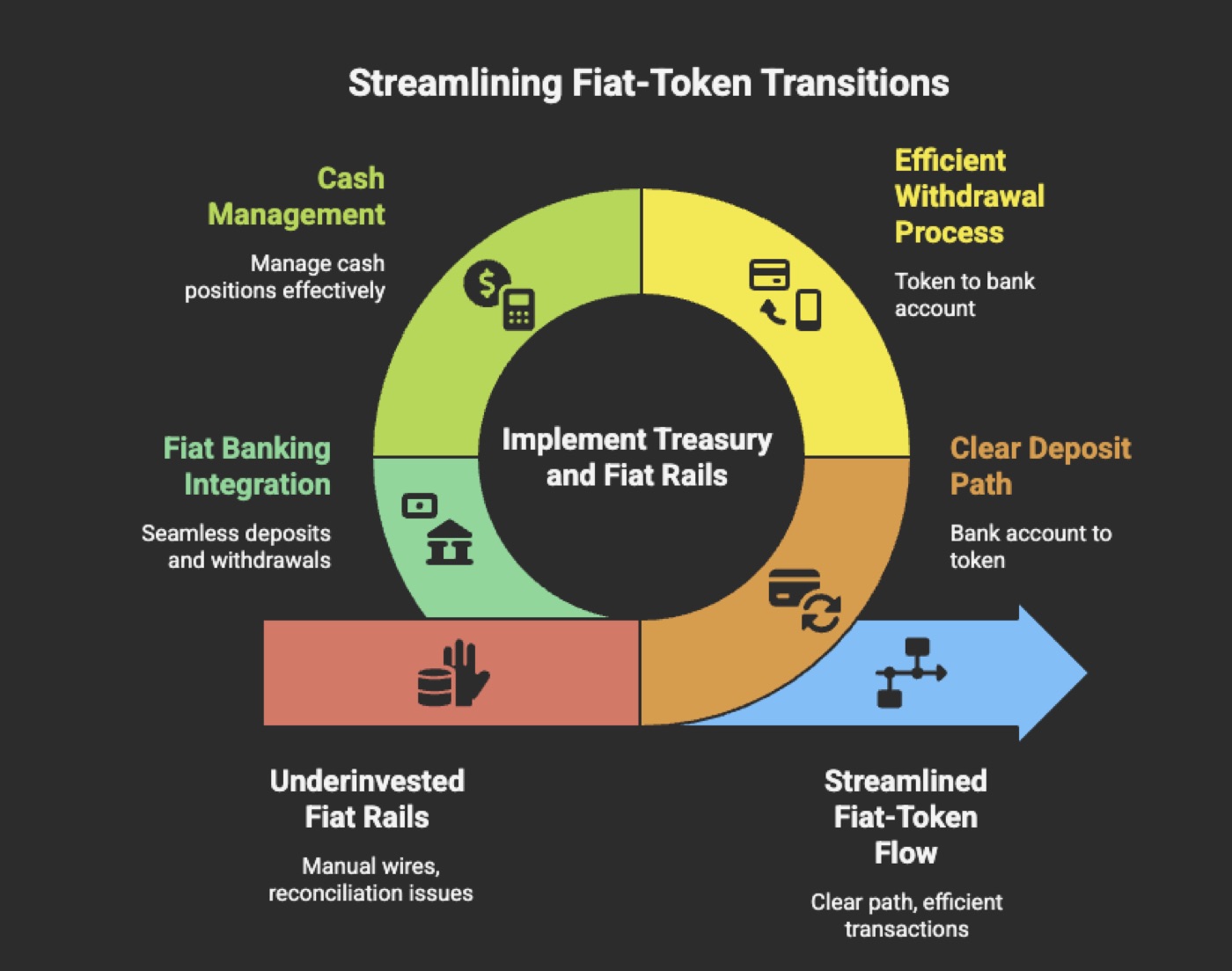
Tokenized real estate still starts with real money: investors deposit cash, subscribe or trade, and eventually withdraw. The fiat–token boundary—deposits, withdrawals, and the cash management in between—is where many projects underinvest. Get it wrong, and you have manual wires and reconciliation; get it right, and you have a clear path from bank account to token and back. Here’s how treasury and fiat rails fit in.
The fiat–token boundary
Investors don’t send tokens to buy tokens. They send fiat: wire, ACH, or other rails. The platform must receive that money, record it (who sent how much, for what), and apply it—to a subscription, a trade, or a wallet credit. Withdrawals work in reverse: request cash out, move from treasury or custody to fiat, and send to the bank. Treasury (cash positions and liquidity) and fiat banking (deposits/withdrawals and bank linkage) are separate concerns: one is “where is the cash,” the other is “how did it get in or out.” Treating them as distinct domains keeps the model clear.
Treasury
Treasury is cash management: balances by account or org, liquidity, and the link between “money in the bank” and “money available for subscriptions or trading.” It sits between banking (in/out) and token operations (subscribe, trade, settle). When an investor subscribes, their fiat has already been received and allocated; treasury ensures the cash side is tracked and available for the issuer or for settlement. Without a treasury layer, you’re stitching bank statements to token activity by hand.
Fiat banking
Fiat banking is the deposit and withdrawal interface: account linkage (which bank account belongs to which investor or org), incoming payment recognition, and outgoing wires or ACH. Compliance and KYC apply at the rails: you need to know who’s sending money and who’s receiving it. Fiat banking and compliance together ensure that only verified, eligible parties move cash in and out.
Escrow in the flow
Between “money received” and “money released to issuer or used for a trade,” escrow can hold funds until conditions are met: subscription closed, milestone certified, or trade settled. Escrow protects both sides and gives the platform a clear place to say “this cash is committed but not yet released.” Treasury, fiat banking, and escrow together form the cash side of the tokenization stack.
End-to-end
The full flow: deposit (fiat banking) → treasury (balance, allocation) → subscribe or trade (primary market or exchange) → custody (tokens and cash positions). Withdraw: custody/treasury → fiat banking → bank. When treasury, fiat banking, and escrow are first-class domains with APIs, that flow is automatable, auditable, and scalable.
API-first integration
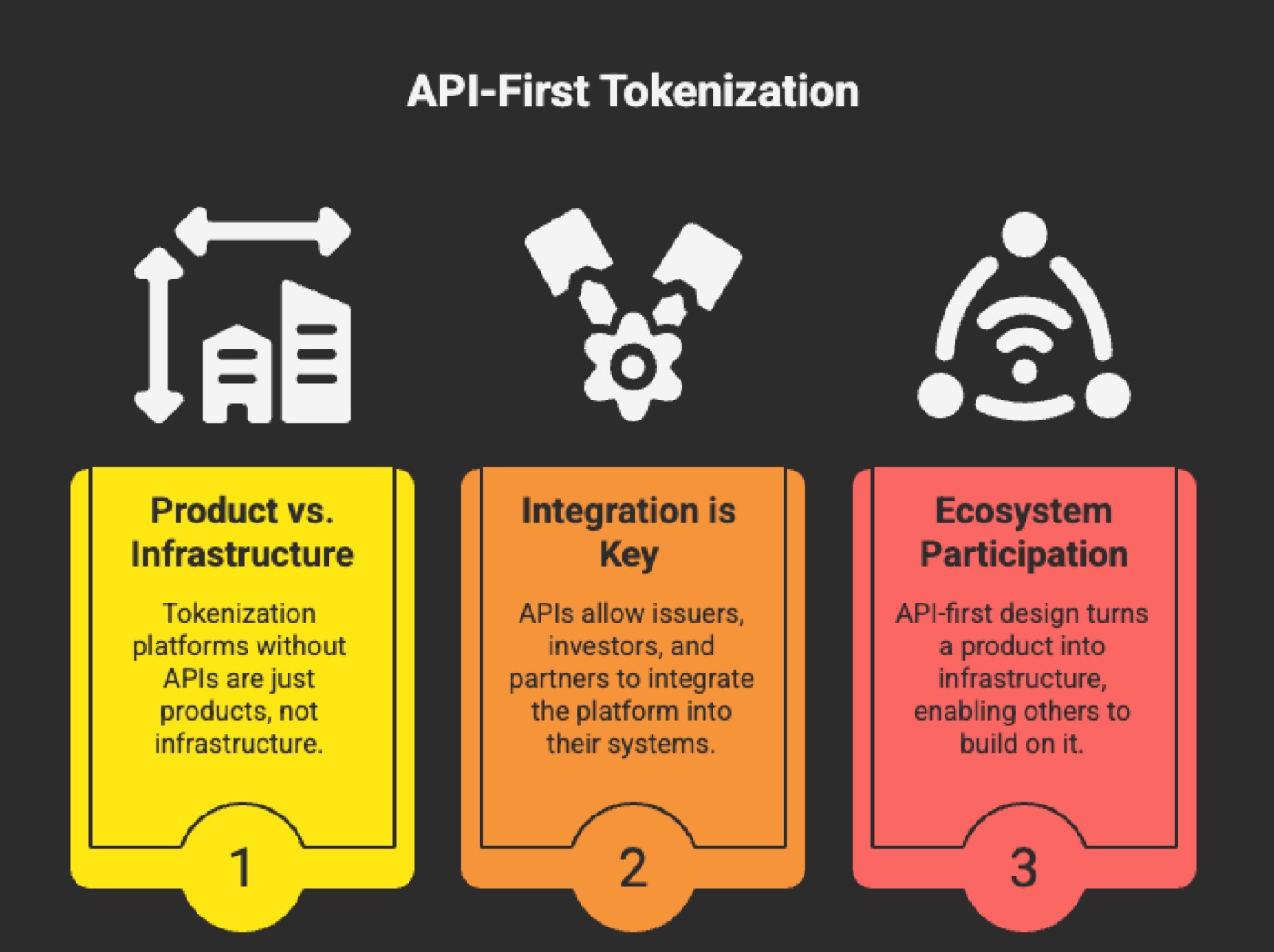
Tokenization platforms that don’t expose APIs are just products—not infrastructure.
If issuers, investors, and partners can’t integrate your platform into their systems, they’re stuck with your UI and your workflow. APIs turn a product into infrastructure: something others build on. Here’s why API-first design matters for tokenization and what it takes to get it right.
Why API-first
Integration is the unlock. Fund admins need to reconcile positions. ERPs need to see subscriptions and distributions. Custodians need to sync with the registry. None of that works without APIs. Composability matters too: primary market, trading, settlement, custody, and compliance should be callable as services so that partners can use the pieces they need and automate the rest. An API-first platform becomes part of the ecosystem instead of a walled garden.
Domain-based design
The platform shouldn’t be one giant API. It should be domain-based: primary market, marketplace, exchange, custody, compliance, transfer agent, treasury, and so on as separate domains with clear boundaries. Each domain has its own resources and operations; operation IDs follow a consistent pattern so that developers and codegen can rely on structure. That keeps the surface area understandable and lets teams own and evolve domains independently.
OpenAPI and consistency
OpenAPI (or equivalent) defines the contract: paths, schemas, and auth. Consistency across domains—same pagination, same error shape, same auth model—reduces cognitive load and enables code generation: types, clients, and validation from the spec. Type safety from API to runtime means fewer integration bugs and faster iteration. Invest in the spec; the rest flows from it.
What developers get
One identity: one set of credentials (org, API key, or OAuth) that works across domains. Consistent patterns: list with cursor and limit, get by ID, standard status codes and error payloads. Sandbox: a full copy of the API surface with test data so that integration and demos don’t touch production. Versioning: clear API versions and deprecation so that integrations don’t break without notice. When developers get that, they can build quickly and confidently.
Real-world use
The proof is in who builds on it: issuers wiring primary market and compliance into their deal flow; investors or custodians pulling positions and corporate actions; partners building white-label or vertical apps. One platform, many use cases—because the APIs are the product. That’s how tokenization becomes infrastructure, not just a single app.
Reporting and analytics
If you can’t measure it, you can’t manage it.
Issuers and investors need to see performance, exposure, and liquidity. Analytics and dashboards turn raw data—positions, trades, distributions, and valuations—into KPIs, trends, and configurable views. When that’s built into the platform as an API and a set of views, reporting becomes a product feature instead of a spreadsheet exercise. Here’s what to build and why it matters.
What issuers and investors need
KPIs: AUM, allocation by asset or product, performance (return, yield), and liquidity. Time-series: how those metrics change over time. Trends: concentration, turnover, and distribution history. Issuers need this for their own books and for investor reporting; investors need it for portfolio monitoring and rebalancing. If the data lives in the platform but there’s no analytics layer, someone will export it and build their own—so build it once, well.
Aggregated metrics
Metrics should be aggregatable: portfolio-level, asset-level, by org, by account, or by product. Configurable dashboards (views) let each org or user choose which widgets and filters they care about. One analytics API can serve many audiences: issuer dashboard, investor portal, compliance report, or internal ops. Aggregation and configuration are what make analytics scalable.
Real estate specifics
For tokenized real estate, metrics include rental yield, occupancy, valuation changes, and distributions (rent or capital events). Capital events (refinancing, sale, development milestone) affect NAV and performance. The analytics layer should support asset-type-specific metrics so that real estate isn’t forced into a generic “position and P&L” box. Same platform, tailored views.
API and flexibility
An analytics API—dashboards, widgets, filters, and time ranges—lets UIs and third parties consume the same data. Embedding and white-label become possible: partners can drop your analytics into their app with their branding. When analytics is API-first, it’s not just for your dashboard; it’s for everyone who builds on the platform.
From data to decisions
Reporting isn’t an afterthought. It feeds allocation (where to invest next), risk (exposure and limits), and compliance (evidence for regulators and allocators). When analytics is part of the stack—with clear ownership of data and definitions—decisions are based on consistent, up-to-date numbers instead of ad hoc exports.
Where to start
Start with the legal structure and the registry of record, because every later decision depends on them. Then connect the money: treasury, bank accounts and escrow. Integration and reporting come last, but design for them from day one, since retrofitting APIs and investor reporting onto a live platform is far harder than building them in.
Further reading: VARA inspection readiness · Supervisors want evidence, not policies