Building an AI Strategy: Vision, Use Cases, Execution
A four-step approach to an enterprise AI strategy: define the AI vision, prioritize use cases, put the enablers in place and execute with monitoring.

AI can create value for companies in various ways: It can enhance productivity, optimize processes, create new processes, and improve the customer experience.
Companies are applying AI to pursue a wide range of goals. First, companies are looking to use AI to make their existing products better. The second reason is to optimizing internal business processes, freeing up workers, and making better decisions.
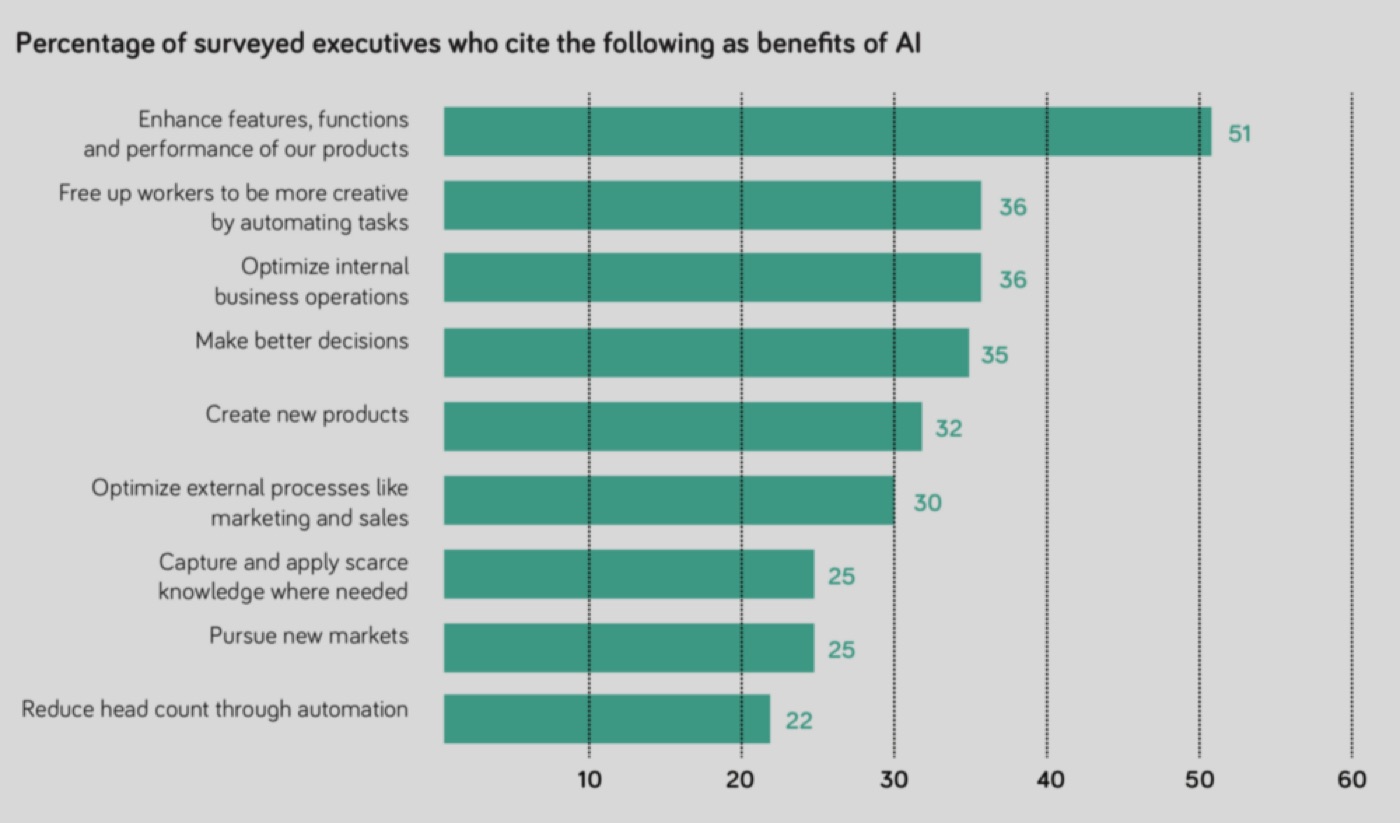
Survey by: Deloitte State of Cognitive Survey
More systematically, the extent to which companies can use AI is defined by two dimensions — the field of application as well as the depth of internal AI knowledge:
The field of application. There are two AI-application fields:
- Product/service-centric AI: Using AI to improve existing products or create new AI-driven products − either specific to one industry (vertical) or generic (horizontal)
- Process-centric AI: Using AI to improve or redesign internal processes
The depth of internal AI knowledge. Companies can use AI with a varying degree of internal knowledge − either doing their own research and development, taking part in joint developments with external developers, or using existing AI solutions.
Taken together, these two dimensions define a company’s potential AI usage.
The systematic approach towards AI ( 4 Steps)**
Applying AI: The elements of a comprehensive AI strategy (initiative for Applied Artificial Intelligence) - Reference
The steps required to develop your AI strategy can be distilled into the four steps:
1- Define your AI vision
The first and central element of any AI strategy is the AI vision. It describes how a company wants to apply AI.
2- Find and prioritize use cases
As a next step, and based on their overall AI vision, companies need to implement a portfolio of use cases. It is important to start thinking of use cases with a final solution in mind:
- How can AI solve a particular problem or improve a particular product?
- At this stage, don’t forget that AI is not and cannot be the solution for everything.
3- Creating the enabling factors
To be able to follow the AI vision and implement the use cases, a set of enabling factors is required: The organization, the people, the technology, and the AI ecosystem. However, the respective importance of the individual factors will differ depending on the aspired-to AI vision.
4- Execution
Finally, the use cases need to be implemented. AI isn’t like traditional software: an AI system learns continuously as new data is fed into the system. Thus, an AI system needs to be monitored to ensure that a model is still delivering the expected results. For this, a company needs to put in place the right processes.
What are your thoughts?